Quick answer
Panic Bar Installation: Installing panic bars, push bars and crash bars for emergency exits. Big Daddy Car Key Replacement provides panic bar installation service in Mission Hills as a mobile service, open 24 hours. Call (562) 550-7206 for a price range and an estimated arrival time.
Last updated
- Service
- Panic Bar Installation
- Area
- Mission Hills, Los Angeles County, CA (91345)
- Hours
- Open 24 hours, 7 days a week
- Service type
- Mobile, at your location
- Category
- Commercial Locksmith Services
- Phone
- (562) 550-7206
On this page
- What panic bar installation means
- Customers we serve in Mission Hills
- When you need panic bar installation service
- Panic Bar Installation across Mission Hills
- Our panic bar installation process, step by step
- Situations we handle regularly
- Equipment and hardware on the van
- A short glossary
- How panic bar installation service is priced
- What you can expect from us
- Tips to avoid problems
- Why this is a job for a locksmith
- What we commit to
- Questions to ask any locksmith
- What to have ready when you call
- Once the work is done
- Related locksmith services in Mission Hills
- Panic Bar Installation near Mission Hills
- Panic Bar Installation in Mission Hills: frequently asked questions
What panic bar installation means
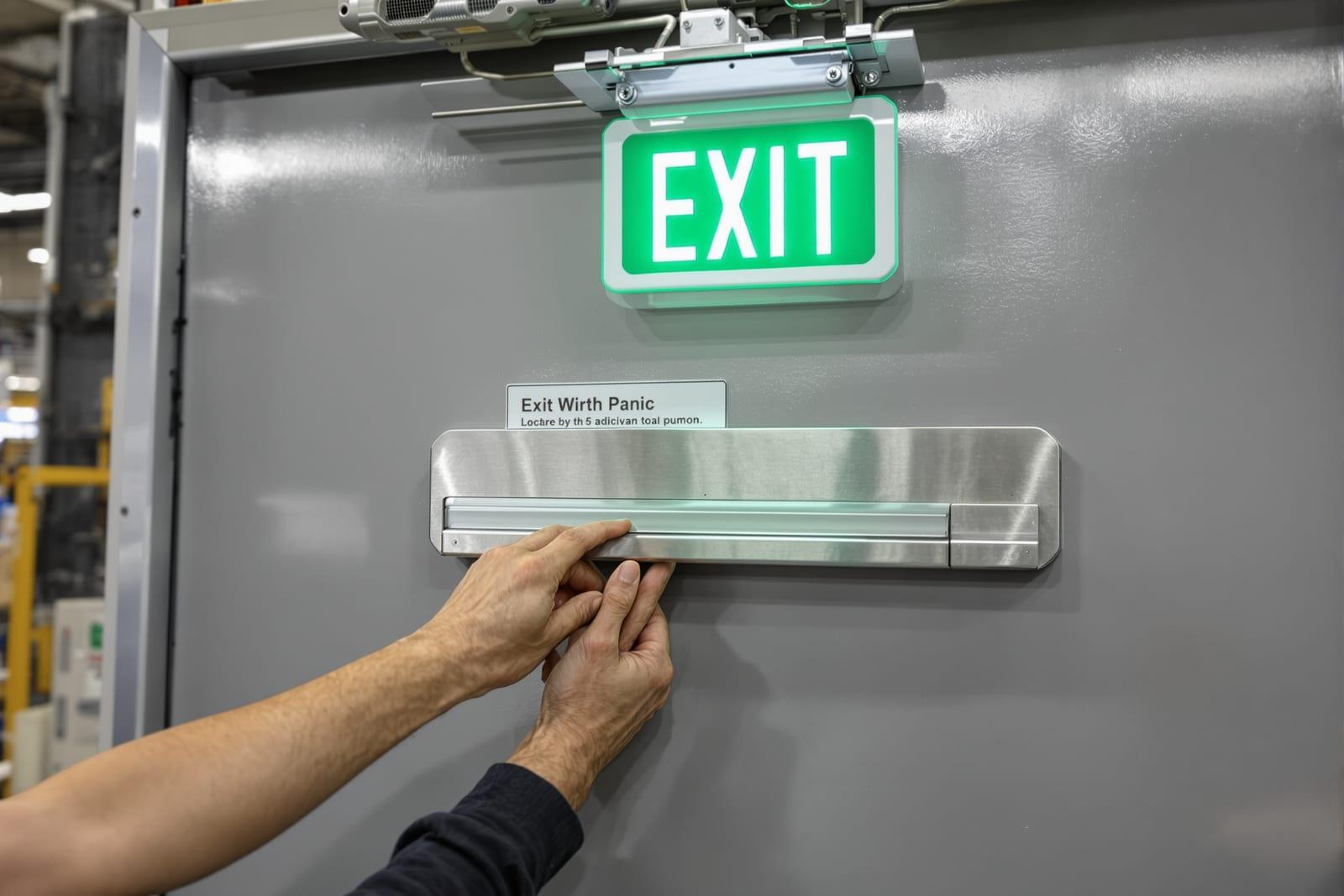
Installing panic bars, push bars and crash bars for emergency exits. A panic bar lets anyone open an exit door by pushing a horizontal bar, with no key or special knowledge, which is what building and fire codes require on many exits. We install rim, mortise and vertical-rod devices, match fire-rated doors with fire exit hardware, and add outside trim or an alarm where needed.
Commercial lock problems cost money by the hour: a store that cannot open, a back door that will not secure, keys in the pockets of former staff. For panic bar installation service in Mission Hills, we send technicians who work with commercial-grade hardware every day and who understand fire, egress and accessibility requirements.
Customers we serve in Mission Hills
Our commercial customers in Mission Hills include retail shops, restaurants, offices, medical and dental practices, warehouses, schools, places of worship, property management companies and homeowners associations. Some need a one-time rekey after a staffing change, others an ongoing arrangement covering key systems, exit hardware and door maintenance across several sites.
This service is part of our commercial locksmith services in Mission Hills.
When you need panic bar installation service
If any of the following sounds familiar, panic bar installation service is likely what you need:
- An inspector required panic hardware on an exit
- An exit is secured with a deadbolt or padlock
- You are opening an assembly or retail space
- A back door needs to lock from outside but open freely from inside
Panic Bar Installation across Mission Hills
Mission Hills is a neighborhood of the City of Los Angeles in Los Angeles County, part of the San Fernando Valley area we cover every day. Our panic bar installation service reaches all of Mission Hills, including the San Fernando Mission district, the Sepulveda Boulevard corridor, and the Rinaldi Street corridor, as well as the streets in between. You do not need to bring anything to a shop. We serve the 91345 ZIP code.
Mission Hills sits where the 405, 5 and 118 meet, a neighborhood of 1950s tract homes and medical offices where commuters regularly need car lockout help and spare transponder keys.
Whether you are at home, at work, or stuck near Mission San Fernando Rey de España, Andrés Pico Adobe, Brand Park, or Providence Holy Cross Medical Center, tell the dispatcher the nearest landmark and we will find you. Depending on where the closest technician is, the drive into Mission Hills follows I-405, I-5, SR-118, Sepulveda Boulevard, San Fernando Mission Boulevard, and Rinaldi Street. You get a realistic arrival estimate when you call.
Our panic bar installation process, step by step
Discuss the need and the site
We ask about the type of business, the doors involved and any deadline, such as an inspection, a tenant move-in or a termination. Photos of the doors help us arrive with the right parts.
Verify authority
Work on a commercial property is done for the owner, the tenant of record, or the property manager. We confirm that before any lock is opened or changed.
Survey the openings
Each door is checked for lock type and function, closer, hinges or pivots, exit hardware and fire rating, so the solution fits both the security need and the code.
Agree scope and price
You receive a clear scope: which doors, what hardware, how many keys, and the cost. For key systems we draft the hierarchy for your approval first.
Carry out the work around your schedule
Rekeys, repairs and installations are done before opening, after closing or during quiet hours when that suits the business better.
Test, document and hand over
Every door is tested for locking, latching and free exit. Keys are stamped and counted, and for master systems you receive a record of what opens what.
On arrival the technician confirms who you are and what is needed, inspects the job, and tells you the price before starting. If the situation differs from what was described on the phone, you hear the options first. Once the work is complete, you try every lock and key yourself and are given an itemized receipt.
Situations we handle regularly
- The back door shows pry marks around the latch after the weekend.
- Staff need access to the sales floor but not the office, stockroom or IT closet.
- You are taking over a suite and need the previous tenant’s keys cut off before move-in.
- A fire inspection notes that the rear exit has a slide bolt and no panic hardware.
- The storefront door will not latch and the shop cannot be left for the night.
- A manager is let go and returns only some of the keys issued.
- A closer has failed and the front door slams hard enough to rattle the glass.
Equipment and hardware on the van
Commercial doors use purpose-built hardware. Aluminum storefronts typically carry Adams Rite-style deadlatches and hook bolts driven by a mortise cylinder. Hollow metal and wood doors use Grade 1 cylindrical levers or mortise locks from makers such as Schlage, Sargent, Corbin Russwin and Yale. Exits use panic and fire exit devices, and closers from LCN, Norton and similar makers control the swing. Interchangeable cores allow fast rekeying. We stock the common cylinders, cams, tailpieces, lock bodies and closers.
A short glossary
- Exit device
- Panic or fire exit hardware that unlatches a door when the horizontal bar is pushed.
- Restricted keyway
- A key profile whose blanks are supplied only to authorized locksmiths, preventing unauthorized copies.
- Interchangeable core
- A removable lock core that a control key releases, allowing a door to be rekeyed in seconds.
- Lock function
- How a lock behaves, such as entry, storeroom, classroom or passage, which determines when it is locked and who can lock it.
- Door closer
- A hydraulic device that closes a door at a controlled speed and holds it latched.
- Cylindrical lock
- A lock installed through a round bore in the door, with the mechanism in the lever or knob assembly.
- Master key system
- A planned arrangement in which each lock has its own key and a master key opens all of them.
- Mortise lock
- A heavy-duty lock housed in a pocket cut into the door edge, combining latch and deadbolt in one case.
How panic bar installation service is priced
- Electrified hardware
- Doors tied to access control, electric strikes or maglocks need wiring and coordination that add time.
- Code and fire-rating requirements
- Fire-rated openings need listed hardware, and exits may need panic devices. Compliance can dictate the product.
- Key system complexity
- A simple rekey to one key is quick. A master or grand master system takes planning, more pinning time and record keeping.
- Restricted or high-security keys
- Patented keyways and high-security cylinders cost more per cylinder and per key, in exchange for real control over duplication.
- Hardware grade and function
- Grade 1 mortise locks and exit devices cost more than cylindrical levers, and they last far longer on busy doors.
- After-hours scheduling
- Work outside normal hours avoids disruption and may be priced differently. We quote both where it matters.
Prices depend on the details above, so the honest way to quote is to ask a few questions first. Call (562) 550-7206, describe the job, and you will hear a price range before anyone drives to Mission Hills. The technician confirms the figure before starting.
What you can expect from us
- A workshop that comes to you
- Our vans carry key cutting machines, key programmers, lock stock and installation tools. Car keys are made beside the car and locks are serviced at your door, so there is no tow and no trip to a shop.
- Non-destructive methods first
- Locks are picked or bypassed and vehicles opened with purpose-made tools wherever possible. Drilling and replacement are last resorts, used only when a lock has truly failed and only with your agreement.
- Open 24 hours, every day
- Lock and key problems do not wait for business hours, and neither do we. A dispatcher answers the phone at any time of day or night, on weekends and on holidays, and sends a technician to Mission Hills.
- Ownership is always verified
- We check identification and proof of ownership or occupancy before opening a door, making a car key or changing a lock. It is the safeguard that stops anyone else from doing the same to your property.
- Car key specialists
- Car keys are in our name for a reason. We cut and program transponder keys, remote head keys and push-to-start smart keys for the great majority of makes, and we tell you honestly when a vehicle needs a dealer-supplied key.
- One company for home, business and vehicle
- The same team handles house lockouts, storefront hardware, master key systems, safes and car keys. You do not need a different number for each kind of lock.
- A real, reachable business
- Big Daddy Car Key Replacement has a published address at 450 W Wilken Way, Anaheim, CA 92802, one phone number and one email address. You always know who you are dealing with.
Tips to avoid problems
- Store spare keys in a locked key cabinet, not a desk drawer.
- Keep a written key log: who holds which key, and the date it was issued and returned.
- Fit latch guards on out-swinging back doors, where the latch is exposed to prying.
- Have storefront pivots and closers serviced before the door starts dragging. It is cheaper than replacing a damaged lock.
- Use a restricted keyway if staff copying keys is a concern. A "Do Not Duplicate" stamp alone does not prevent copies.
- Test exit devices and door closers monthly. A door that does not latch is an unlocked door.
- Give each employee access only to the doors their job requires.
- Never chain, padlock or bolt a required exit door while the building is occupied.
Why this is a job for a locksmith
Commercial doors are regulated in ways that homes are not. The wrong lock function can trap someone inside a storeroom, a deadbolt on an exit can fail an inspection or cost a life, and unlisted hardware can void a fire door’s rating. A commercial locksmith knows the functions, the grades and the applicable codes, keeps your key system mathematically sound, and documents the work so the next change is straightforward.
What we commit to
We keep to a consistent set of standards on every call. You hear a price range before dispatch and a confirmed price before work begins. Identification is checked, because the same care that slows a job by a minute protects your own property from someone else. Non-destructive methods come first. You try every key and lock yourself before the technician leaves, and you are given an itemized receipt.
Questions to ask any locksmith
- Expect the technician to ask for your identification. A locksmith who opens doors without checking who is asking is a risk to everyone.
- Ask for the legal business name and where the company is based. A legitimate locksmith answers the phone with a name, not a generic phrase.
- In California, locksmith companies are licensed by the Bureau of Security and Investigative Services. You can ask for the license number and check it on the state’s website.
- Be cautious of advertised service fees that seem far too low. The final bill in those cases is often many times higher.
- Keep the number of a locksmith you trust in your phone, so you are not choosing one under pressure.
- Ask whether the lock will be picked or drilled. Standard locks rarely need drilling, and you should be told why if it is proposed.
- Get an itemized receipt showing labor, parts and the business details.
- Ask for a price range for your specific job before anyone is sent, and confirm the price on site before work starts.
What to have ready when you call
- Your exact location: a street address, or a cross street and a landmark if you are in a parking lot or on the road.
- What you need help with: the type of door, lock or vehicle, and what has happened.
- For vehicles, the year, make and model, and whether you have any working key.
- A photo ID, and something that connects you to the property or vehicle, such as registration, a lease or a utility bill.
- A phone number where the technician can reach you on the way.
- Any detail that affects access: a gate code, a parking level, a guard desk or a locked lobby.
Once the work is done
Keep the receipt from your visit. It lists the hardware fitted and the work carried out, which is useful for insurance, for a landlord or homeowners association, and for anyone who works on the same locks later. Make a note of who holds each new key and where the spares are kept. If anything we worked on does not feel right in the days that follow, call (562) 550-7206 and tell us what you have noticed so it can be looked at promptly. When circumstances change, such as a new tenant, a new employee or a new vehicle, the same number reaches us at any hour.
Related locksmith services in Mission Hills
Customers who need panic bar installation service often ask about these as well. Each can usually be handled in the same visit to Mission Hills.
- Panic Bar Repair
Repairing panic bars that stick, fail to latch, alarm or do not open correctly.
- Restricted Key Systems
Installing key systems that prevent unauthorized key duplication.
- Automatic Door Closer Adjustment
Adjusting speed, latch, sweep and backcheck settings.
- Desk Lock Repair
Repairing locks for desks, drawers and office furniture.
- Commercial Door Hardware
Supplying and installing commercial-grade levers, pulls, hinges, closers, exit devices, strikes and protective plates.
- Retail Store Locksmith Service
Lock repair, rekeying, high-security locks and emergency unlocking for retail stores.
- Apartment Building Locksmith
Common area locks, unit rekeys, mailbox locks, access control, gate locks and emergency exit hardware.
- IC Core Lock Systems
Installing and rekeying interchangeable core lock systems for commercial properties.
- Commercial Lock Installation
Installing heavy-duty locks for business properties.
- Commercial Door Hardware Repair
Repairing commercial handles, hinges, closers, locks, latches, strikes, pivots and door frames.
- Safe Locksmith
Opening, repairing, servicing and changing combinations on home and business safes.
- Car Lockout
Unlocking vehicles when keys are locked inside.
- Mailbox Lock Replacement
Replacing mailbox locks when keys are lost, tenants move out or the lock is damaged.
- Rekey Locks
Resetting your existing locks to a new key so previous keys stop working, without replacing the hardware.
- Transponder Key Programming
Programming chip keys for vehicles with immobilizer systems.
Panic Bar Installation near Mission Hills
We provide the same panic bar installation service in the communities around Mission Hills. See the main panic bar installation page or the full list of service areas.
- Panic Bar Installation in North Hills
- Panic Bar Installation in Arleta
- Panic Bar Installation in Pacoima
- Panic Bar Installation in San Fernando
- Panic Bar Installation in Panorama City
- Panic Bar Installation in Granada Hills
- Panic Bar Installation in Sylmar
- Panic Bar Installation in Lake Balboa
- Panic Bar Installation in Northridge
- Panic Bar Installation in Van Nuys
- Panic Bar Installation in Valley Glen
- Panic Bar Installation in Porter Ranch
Panic Bar Installation in Mission Hills: frequently asked questions
When is a panic bar required?
Model codes used in California generally require panic hardware on exit doors serving assembly and educational occupancies with 50 or more occupants and certain hazardous areas. Your local fire marshal or building official makes the final determination for your space.
Who is allowed to authorize lock changes for a business?
The owner, the tenant named on the lease, or the property manager. We verify authority before changing or opening any commercial lock.
Are our exit doors compliant?
We can check that exit doors open with one motion and no key, that panic hardware is present where required, and that closers latch the doors. Final authority rests with your fire marshal or building official.
Can you provide documentation for our records?
Yes. For rekeys and key systems we provide a key schedule listing doors, key numbers and the quantity of keys issued.
Do you offer ongoing service for multiple locations?
Yes. We service multi-site businesses and managed properties across our service area and keep key records so later changes are fast.
Can you work outside our business hours in Mission Hills?
Yes. We are open 24 hours and regularly schedule rekeys, repairs and installations before opening or after closing so customers and staff are not disturbed.
What brands of commercial hardware do you service?
We work with the major commercial lines, including Schlage, Sargent, Corbin Russwin, Yale, Best, Adams Rite, Von Duprin, LCN, Norton and Kaba, and can match most existing hardware.
How do we stop employees from copying keys?
Install a restricted key system. Its blanks are available only through the authorized locksmith and copies are cut only for people on your signature list.
How long does it take a locksmith to reach me in Mission Hills?
It depends on where the nearest technician is and on traffic along I-405, I-5, or SR-118. We give you a specific estimated arrival time when you call (562) 550-7206, not a blanket promise.
Is there a travel charge for Mission Hills?
Any travel charge is part of the price range you are given on the phone before a technician is dispatched to Mission Hills, so you know the cost in advance.
Are you open 24 hours in Mission Hills?
Yes. We take calls and dispatch to Mission Hills 24 hours a day, including weekends and holidays.
Do you check identification?
Yes. We verify identity and ownership or occupancy before opening locks, making vehicle keys or changing locks.
Do you only make car keys?
No. Car keys are our specialty, and we also provide residential, commercial and emergency locksmith services: lockouts, rekeying, lock installation and repair, door hardware, access control, safes and more.
Is Big Daddy Car Key Replacement a mobile locksmith?
Yes. Our technicians travel to you throughout Los Angeles County and Ventura County. Keys are cut and programmed, and locks are opened, rekeyed, repaired and installed, at your location.
Can I book an appointment in advance?
Yes. Non-urgent work such as rekeying, lock installation, spare car keys and commercial projects can be scheduled for a time that suits you.